
Fort Dodge Directory Collections
Fort Dodge city directories survive through several collections rather than one complete, year-by-year shelf list. The Fort Dodge Public Library local-history collection confirms city directories, plat maps, school yearbooks, newspaper microfilm, and local birth, marriage, baptism, and cemetery indexes. Its inspected catalog does not publish every directory year or publisher, so researchers should ask staff to confirm a volume before planning a visit.
| Collection | Years | Where held | Access route |
|---|---|---|---|
| White and Yellow Pages | 1923–1944 | Library of Congress | Digitized microfilm reel online |
| Local city directories | Exact run not posted | Fort Dodge Public Library | Ask staff or consult in person |
| Fort Dodge newspapers | Earliest titles to 1861; Messenger microfilm 1872–2019 | Fort Dodge Public Library | Microfilm, online archive, and staff help |
| Maps, yearbooks, local indexes | Varies by series | Library and historical groups | Library, appointment, or archive request |
The verified online run is the Library of Congress Fort Dodge reel. It mixes residential, classified, and telephone material. A gap in the table does not prove that no volume exists. It means the year was not confirmed in the official pages reviewed for Fort Dodge.
The library’s collection page shows the local research shelf and its access choices.
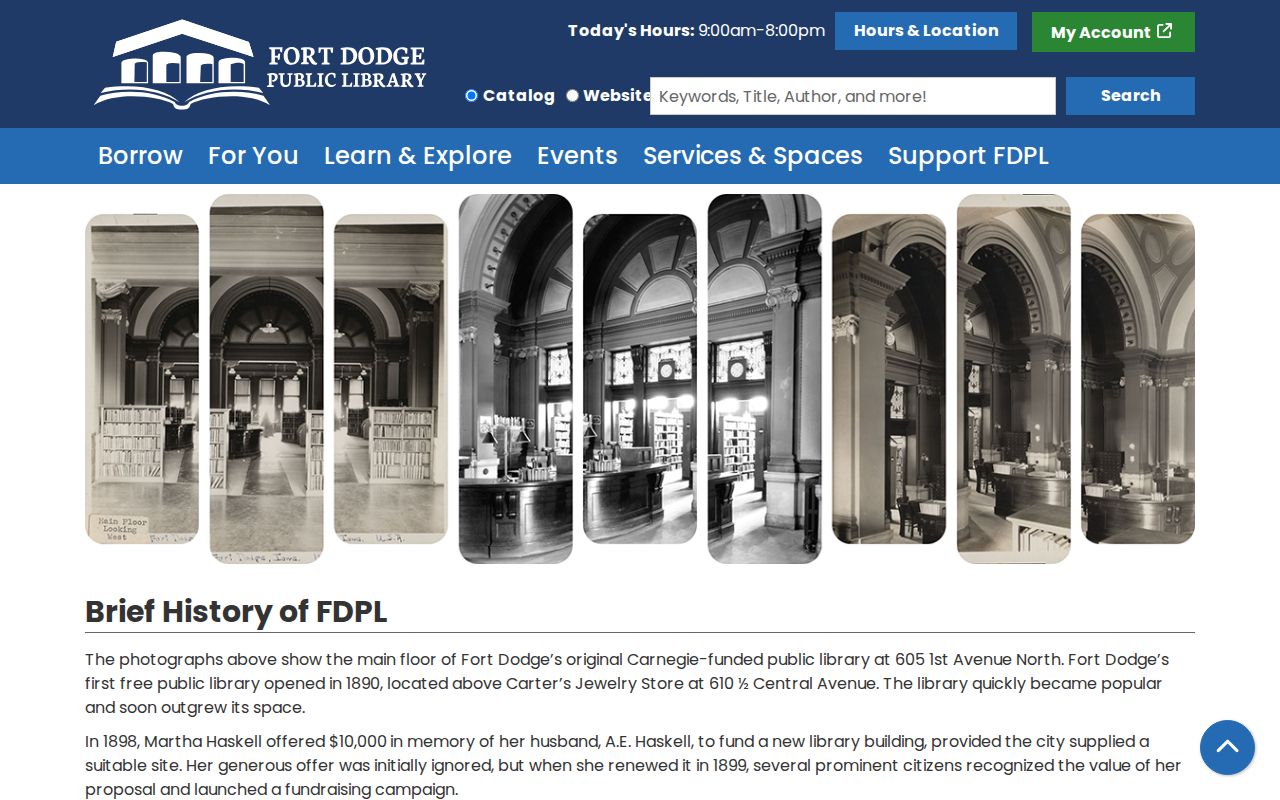
The image is a useful starting point for checking which Fort Dodge city directory, newspaper, map, or index can answer a dated question.
Fort Dodge Library Research Desk
The library at 424 Central Avenue is the practical local hub. It has a microfilm reader-printer and staff who may perform a focused search for a remote user. Give a full name, variant spellings, the event type, a likely newspaper, and a specific date or at least a month and year. An approximate name and year may work, but staff time is limited. The branch information page lists phone 515-573-8167 and the current weekly schedule.
The posted hours are Monday and Tuesday, 9:00 a.m. to 8:00 p.m.; Wednesday through Friday, 9:00 a.m. to 5:30 p.m.; and Saturday, 9:00 a.m. to 1:00 p.m. Sunday is closed. Check holiday hours first. Ancestry Library Edition is available only inside the library. Fold3 and HeritageQuest are available with a library card, and HeritageQuest includes federal census material through 1940.
The official branch listing supplies the access details needed before an in-person Fort Dodge directory visit.
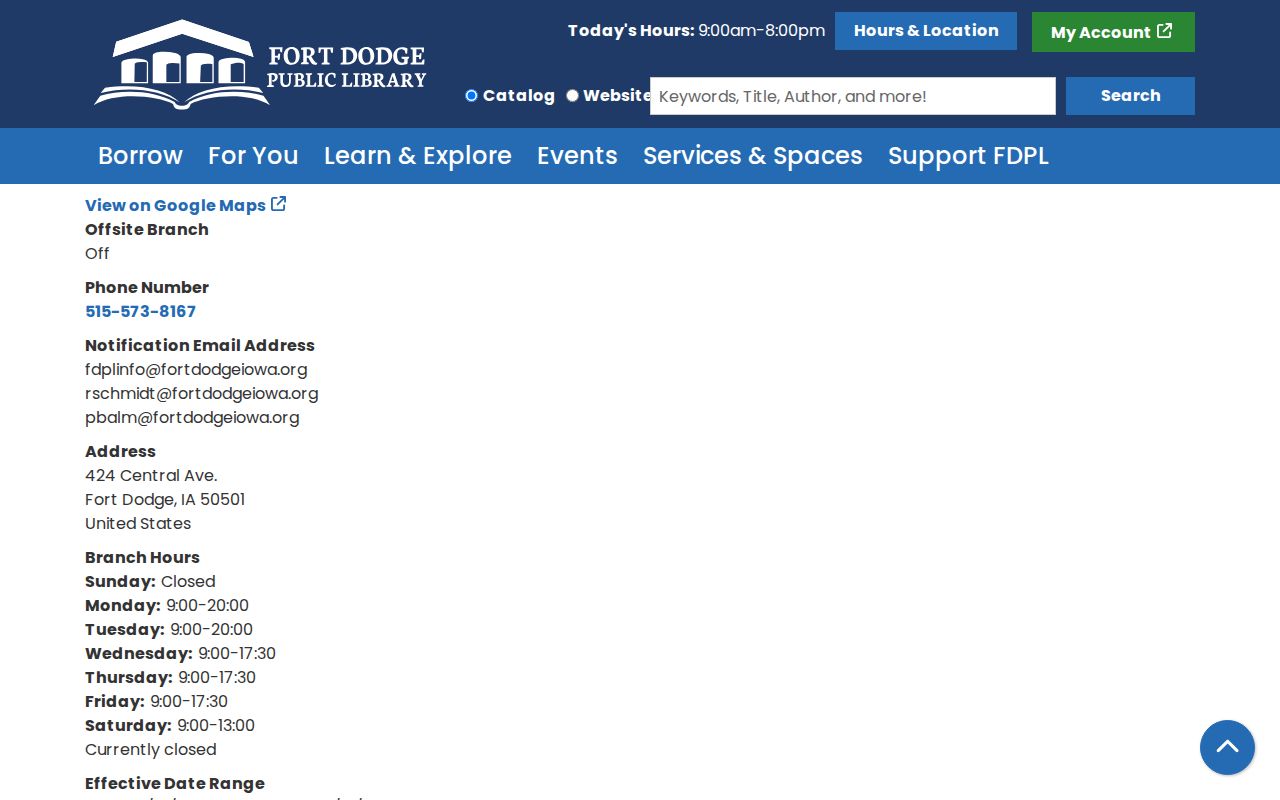
Use those details to confirm the building is open and that the desired reader, volume, or staff service is available.
Note: Ask for a named year and source series, since a request for every record about one person is too broad for efficient staff research.
Read Fort Dodge Directory Entries
A Fort Dodge city directory entry is a dated snapshot. On the inspected Library of Congress material, a residential listing can show a surname, initials or given name, the label res, and a street address. Classified pages can name a business, its address, and its telephone exchange. The key printed near the front explains the volume’s short forms, so save that page before interpreting any mark.
| Name | Copy the printed spelling, initials, and sequence exactly. |
|---|---|
| Listing type | Note whether the page identifies a residence, business, or classified entry. |
| Address | Record the house number, street, room, or upper-floor notation as printed. |
| Phone detail | Preserve the exchange and number without treating it as current. |
| Year and page | Cite the directory date and image or page number for later checks. |
- Criss-cross directory
- A later directory section arranged by street or telephone number instead of surname.
- Householder index
- A list of named household contacts, often tied to a street address.
- Abbreviation key
- The volume’s own legend for shortened words, symbols, and listing types.
Do not infer an unprinted spouse, ownership status, or exact trade. Fort Dodge’s verified samples support only the fields visible on their pages. A directory address should be tested against a map, deed, census, or newspaper before it is joined to the wrong same-name person.
Fort Dodge’s 1928 Street Index
A federal HABS study shows how a city directory can unlock one Fort Dodge block. Researchers used the 1928 street index after consulting Sanborn maps for 16 through 22 South Sixth Street. The index associated 16 South Sixth with Rudolph C. Becher, 18 with Imperial Lunch and John Rizos, 20 with Joseph E. Koll’s cigar business, and 22 with Ferris D. Daniel’s clothing business. Upper-floor room and household entries added more detail.
This is a historical example, not a current claim. Its value lies in the method: start with the street-order page, record every unit or floor marker, then check the alphabetical page. A map helps establish which building stood on the lot. A newspaper ad or legal notice can date a change. A deed answers ownership questions that a Fort Dodge city directory cannot settle.
Fort Dodge Directories Meet Newspapers
The library’s newspaper files bridge changes between directory editions. Local paper access reaches back to 1861, while Fort Dodge Messenger microfilm spans 1872 through 2019. The local and Webster County digital archive is described as covering 1856 through 1934, depending on title. A separate Messenger archive covers 1910 through 2019. These ranges overlap but are not identical.
Search a name, address, and date range after locating a directory entry. Birth, marriage, death, probate, property-transfer, council, school, church, and business notices may explain why a person appears, moves, or vanishes. Cite the paper title, date, and page when possible. Material after 1924 is restricted to library computers or library Wi-Fi because of copyright, so a remote reader may need staff help or an on-site visit.
The digitized archive landing page shows the search route that complements Fort Dodge city directories.
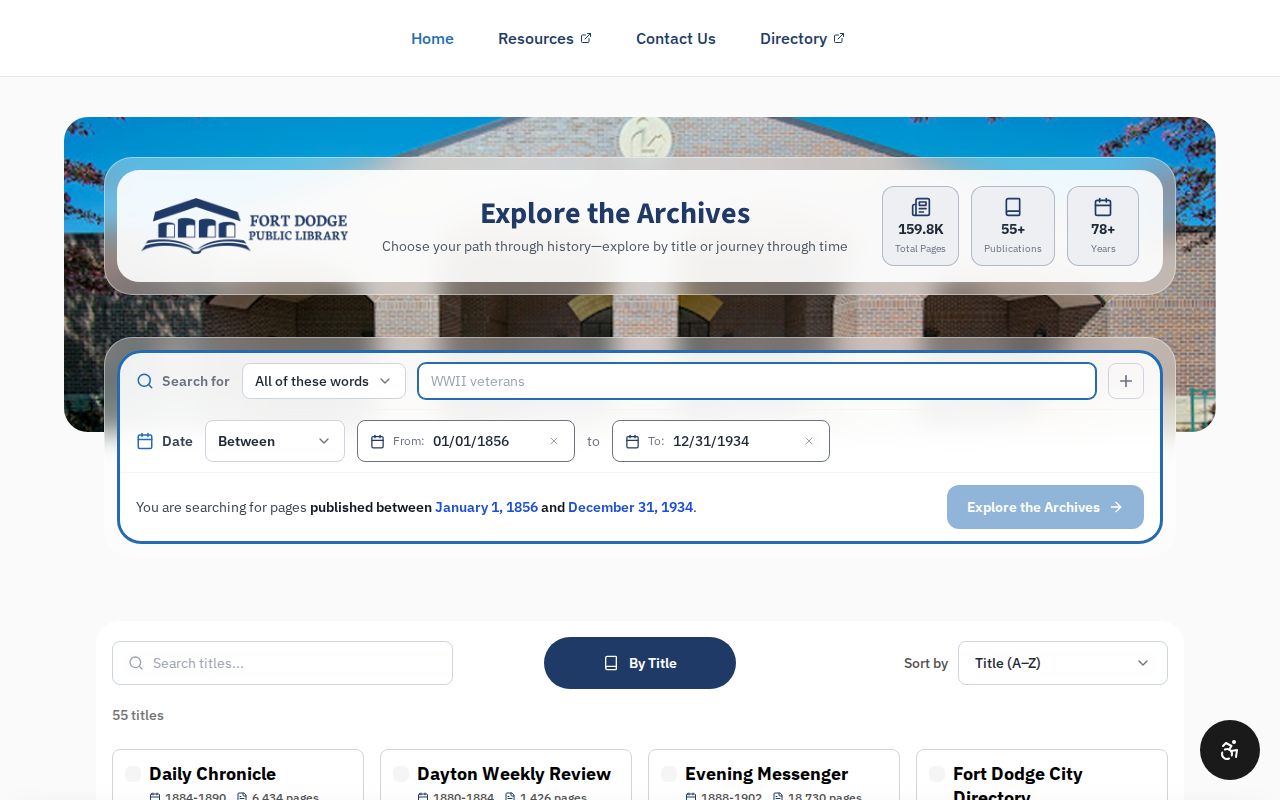
A dated clipping can explain a move or event, but it should be checked against the original directory and another official record.
Fort Dodge Historical Collection Stops
The Webster County Historical Society occupies Room 143 inside the library. Volunteers staff it Monday through Thursday from 2:30 to 5:30 p.m., Friday hours vary, and Saturday visits from 9:30 a.m. to 12:30 p.m. are by appointment. Confirm before arriving. The library also identifies the Webster County Genealogical Society at the Fort Museum and Frontier Village, 1 Museum Road, with phone 515-573-4231.
The Fort Museum collection supplies place context for a family or address found in a Fort Dodge city directory. Its history connects the Des Moines River and Lizard Creek junction to a military outpost selected in 1835, construction in 1850, and William Williams’s later town plotting. Museum buildings and artifacts cover the nineteenth and early twentieth centuries. They support local history, but do not prove a named person occupied a specific parcel.
The museum’s official overview shows the kind of place-based material available beyond the city directory shelf.
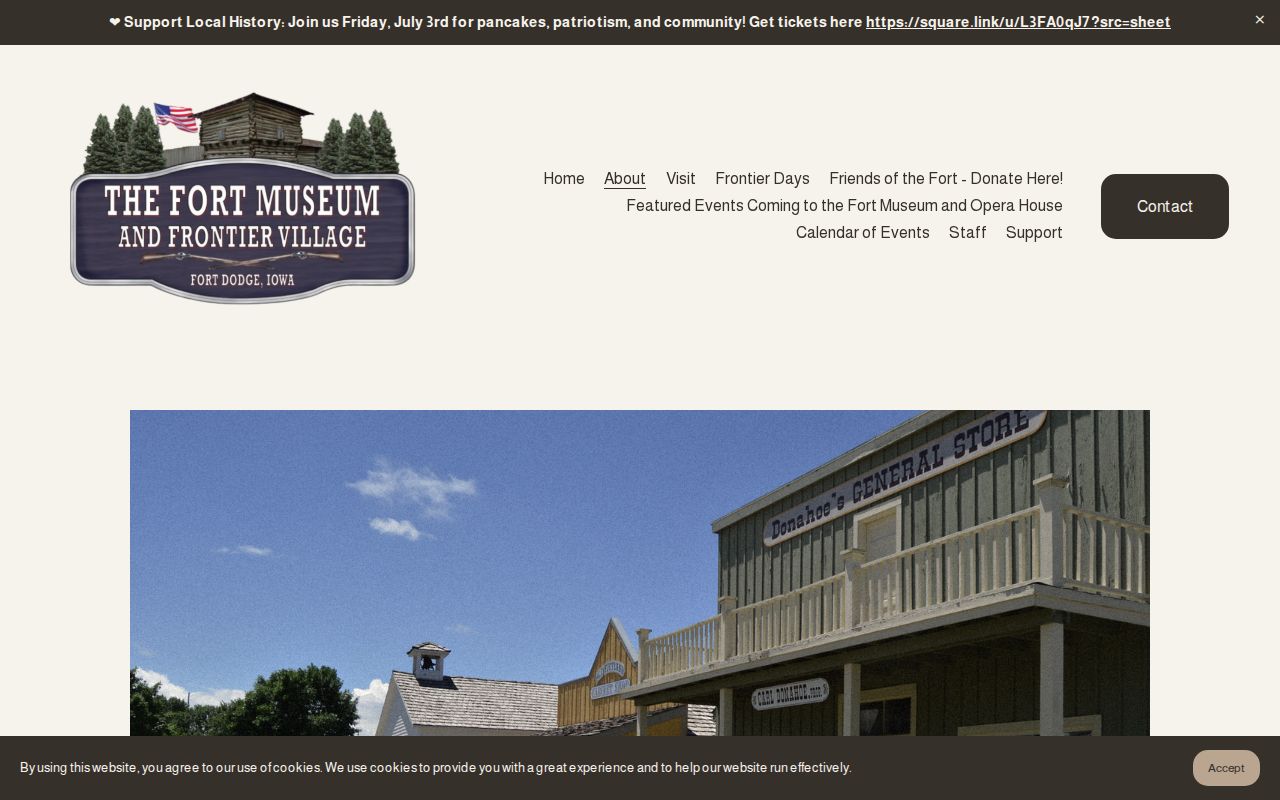
Pair museum context with a dated directory page, map, newspaper, or county series before drawing a family conclusion.
Trace Fort Dodge Directory Families
Following one household works best as a dated chain. A missing listing can mean a move, death, change of name, unlisted phone, publication gap, or indexing error. It does not prove what happened. Keep a simple log with the year, printed name, address, page, and source repository.
- Find the earliest likely surname entry and save the directory date, page, and abbreviation key.
- Move forward one available volume at a time, recording name variants and each address change.
- Use any street-order section to check the building and nearby listings without assuming family ties.
- Pair directory years with federal or state census records, plat maps, and the 1912 Sanborn sheets.
- Test the last appearance against newspapers, cemetery indexes, probate dockets, and eligible vital-record channels.
School yearbooks from Fort Dodge Senior High and St. Edmond Catholic High can confirm a class year, club, or photograph. Plat maps connect town lots and owner names. Cemetery and vital sources can close a deceased person’s trail, but certified records have eligibility rules. For modern address-keyed research, use the Fort Dodge street directory rather than stretching an old volume into a present-day record.
Fort Dodge Directory Time Marks
The surviving sources create a reproducible timeline even though no complete local publisher inventory was found. Each milestone identifies a different kind of evidence and a different access point.
| Date | Fort Dodge source milestone | Research use |
|---|---|---|
| 1861 | Earliest local newspaper availability stated by the library | Names, events, notices, and address clues |
| 1903 | Carnegie library dedicated | Institutional context for the local collection |
| 1912 | Library of Congress Sanborn set, 33 sheets | Buildings, alleys, materials, and uses |
| 1923–1944 | Library of Congress Fort Dodge directory reel | Residential and classified listings |
| 1872–2019 | Messenger microfilm span | Events between available directory years |
The Fort Dodge CivicWeb archive adds modern council agendas, minutes, ordinances, and reports. A person, street, or project named there can extend a historic directory lead into the city’s document trail, while the City Clerk remains the fallback for an existing record not found online.
The city portal image marks that newer end of Fort Dodge’s record timeline.
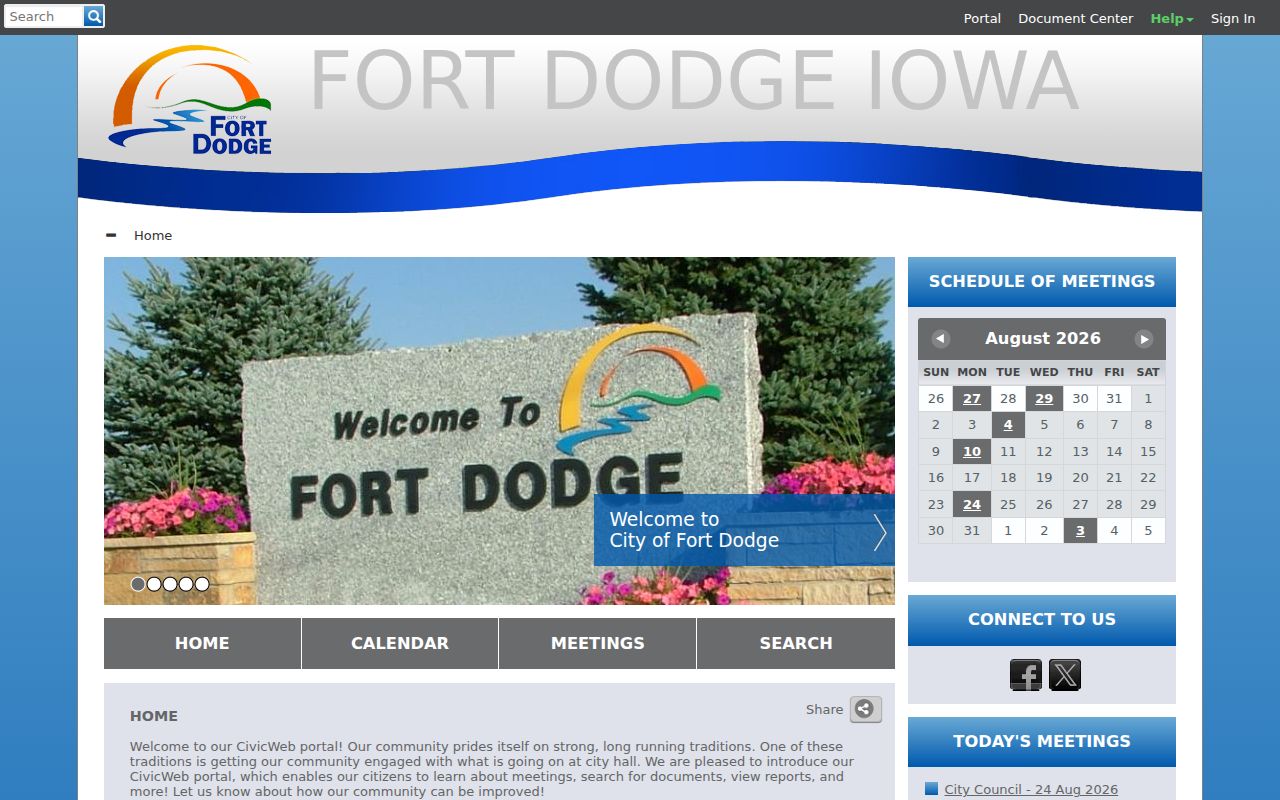
Use its title and meeting date alongside the older city directory citation so readers can reproduce the search.
For older county material, the State Historical Society of Iowa’s Webster County catalog identifies actual series rather than loose name matches. Its entries cover deeds, town lots, homesteads, probate, naturalization, marriages, births and deaths, chattel mortgages, and tax lists across differing date spans. Start with the series title and date range, then ask the archive for the specific item. This route is especially useful when a library volume places someone in Fort Dodge but the next available edition leaves a gap. The catalog does not replace the original record, yet it tells a researcher which custodian and record group can bridge the missing years.